Why Your First Workout Back After a Break Makes You Sweat Differently
Quick Answer: Heat acclimatisation decays quickly. After about two weeks off, your sweat response starts later, produces less volume for the same core temperature, and loses more sodium because the reabsorption mechanism in the sweat gland becomes less efficient. Plasma volume also drops. The result is a body that stores heat faster and cools less well — which is why the first session back feels far harder than your fitness loss alone explains.
You lost two weeks, not two months. Your times should be barely affected.
They are not, and a large part of the reason is thermoregulation rather than fitness.

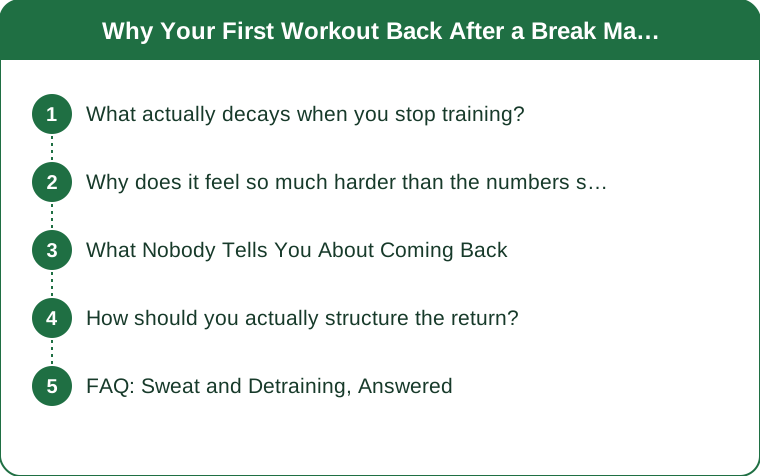
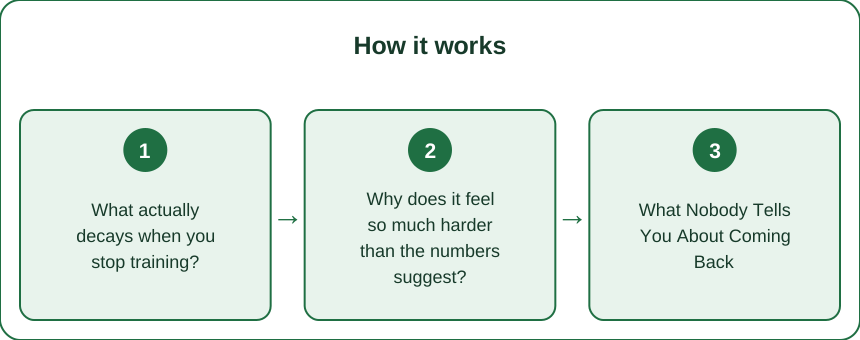
What actually decays when you stop training?
Several things at once, and they decay at very different rates.
Plasma volume falls fastest. Regular training expands blood plasma by a meaningful amount, and that expansion is one of the earliest adaptations to appear and one of the earliest to go. Studies of detraining commonly find noticeable plasma volume reduction within the first week to ten days. Less plasma means less blood available for both working muscle and skin blood flow, and skin blood flow is how heat gets to the surface.
Sweat onset shifts later. In an acclimatised person, sweating begins at a lower core temperature — the body starts cooling early rather than waiting. Detraining pushes that threshold back up, so you accumulate more heat before the cooling system engages.
Sweat sodium concentration rises. The sweat gland reabsorbs sodium from the fluid as it travels up the duct, and training makes that reabsorption more efficient. Lose the adaptation and your sweat gets saltier — noticeably so, as gritty residue on skin and clothing.
Sweat distribution becomes less even. Acclimatised sweating is distributed more widely across the body; detrained sweating concentrates more on the torso and head, which is a less efficient use of surface area.
And VO2max declines comparatively slowly — typically only a few percent in the first two to three weeks. This mismatch is the crux of it. Your engine is nearly intact; your cooling system is not, and the session feels hard because of the second one.
Why does it feel so much harder than the numbers suggest?
Because perceived effort tracks thermal strain closely, and thermal strain has gone up more than metabolic demand has.
Core temperature and heart rate are both major inputs into how hard something feels. With reduced plasma volume, heart rate for any given pace runs higher — a phenomenon called cardiovascular drift, and it is exaggerated in the detrained state. With delayed sweating, core temperature climbs sooner and higher. Both signals say the same thing to your brain: this is harder than it should be.
You are also competing for blood flow. Skin needs blood for cooling; muscle needs blood for work. With a smaller total volume to allocate, both get less, and the compromise shows up as an elevated heart rate at a pace that used to be easy.
The sensation people describe is specific: legs feel fine for the first ten minutes, then the whole thing becomes heavy in a way that does not feel muscular. That is a heat and circulation story, not a strength one.
Time of year matters enormously here. A break taken in cool weather and a return in warm weather stacks the problems — you lost acclimatisation and also increased the demand. This is exactly the pattern behind a rough first week back after a summer holiday, and behind the classic miserable first session of the autumn term for anyone who took August off.

What Nobody Tells You About Coming Back
Reacclimatisation is much faster than the original acclimatisation. Building heat adaptation from scratch takes roughly 10-14 days of consistent exposure. Rebuilding it after a short break commonly takes half that, sometimes less. The first session is the worst one you will have, by a wide margin.
Plasma volume responds within days. It is one of the quickest adaptations to return, which is why session three often feels dramatically better than session one even though nothing about your fitness changed in 96 hours.
Salt loss is worth taking seriously in that first week. Saltier sweat plus a body unaccustomed to the losses is the combination that produces post-session headaches and unusual fatigue, particularly after longer sessions. Adding electrolytes rather than plain water for anything over an hour is genuinely useful during the return week, and less useful once you are reacclimatised.
A break does not have to be complete to cause this. Reduced training intensity, or moving from outdoor to air-conditioned indoor training, produces a partial version of the same decay. People who train through a holiday in a hotel gym still often come back with reduced heat tolerance.
Illness accelerates all of it. A week off with a virus produces more decay than a week off on holiday, because of dehydration, fever-related fluid loss and reduced food intake on top of inactivity.
And the first session back is where most return injuries happen — not because muscles are weak, but because the thermal strain degrades coordination and judgement late in a session, and that is when people push to prove the break did not matter.
How should you actually structure the return?
Deliberately underdo the first three sessions, and let the physiology catch up.
Session one: half the duration, easy intensity, and stop while it still feels manageable. The goal is exposure, not stimulus. You are prompting plasma volume restoration and sweat gland reactivation, both of which happen at low intensity.
Sessions two and three: build duration before intensity. Time at moderate effort drives reacclimatisation better than short hard efforts do. Add intensity in the second week.
Hydrate before, not just during. Starting a session already down on fluid compounds a plasma volume deficit you have not yet recovered.
Use electrolytes during the first week for anything over 45-60 minutes, particularly in warm conditions. Then taper that back as normal.
Expect a higher heart rate and do not chase your old paces. If you train by heart rate, your usual zones will produce slower paces for two weeks or so. That is the system working correctly, and forcing the pace at the old heart rate is how a return becomes an injury.
Dress for a body that cools badly. Lighter kit than you would normally choose for the conditions, at least for the first week.
And watch the genuine warning signs. This is general information, not medical advice. Stopping sweating while still working hard, feeling cold or getting goosebumps in the heat, dizziness, nausea, confusion or a headache that arrives during rather than after exercise are all reasons to stop immediately and cool down — not signs to push through. Heat illness is considerably more likely in the deacclimatised state, which is precisely the state you are in on your first session back.
FAQ: Sweat and Detraining, Answered
How long before I lose heat acclimatisation completely?
Decay begins within days and is substantial by two to three weeks, with most of the adaptation gone by around a month for most people. It is not binary though — partial acclimatisation persists and makes rebuilding faster, which is why someone returning after three weeks reacclimatises far quicker than someone acclimatising for the first time.
Does sweating more mean I am fitter or less fit?
Fitter, generally, and earlier rather than more is the key marker. Trained and heat-acclimatised people begin sweating at a lower core temperature and sweat more efficiently, which is a better cooling system rather than a worse one. Sweating heavily but only after you are already overheated is the less desirable pattern.
Will a sauna help me get it back faster?
There is reasonable evidence that passive heat exposure contributes to acclimatisation, and it is used deliberately by some athletes. As a way to soften a return to training, sessions of moderate duration after easy exercise are the usual approach. It is not a substitute for actually training in the conditions, and it is not appropriate for everyone — cardiovascular conditions, pregnancy and some medications all change the risk calculation, so check first.
TL;DR:
- Two weeks off costs you little VO2max but a great deal of heat acclimatisation and plasma volume.
- You sweat later, less evenly, and with more sodium — so you store heat faster and cool worse.
- Perceived effort tracks thermal strain, which is why the session feels far harder than your fitness loss explains.
- Reacclimatisation takes roughly half as long as the original adaptation; session three usually feels transformed.
- Return with shorter easy sessions, build duration before intensity, use electrolytes for the first week, and treat heat-illness signs as stop signals.
The practical value in knowing this is mostly psychological: the first session back is not evidence that you lost everything. It is evidence that one specific system, which rebuilds quickly, is temporarily offline. Give it three sessions before drawing any conclusions about your fitness.
Keep Reading
This article is for general informational and styling purposes only. Fit, sizing, and product availability may vary.