Why You Sweat More Indoors in Autumn Than You Did Outdoors in Summer
Quick Answer: Three things change at once in autumn. Buildings switch the heating on, so indoor gyms often run warmer than the summer air you trained in. You arrive in more clothing and keep layers on longer. And heat acclimatisation - the adaptation your body built over summer - begins to fade within a couple of weeks of cooler weather, which changes how and when you sweat. The result is more sweat at lower ambient temperatures, which feels backwards and is entirely normal.
You are not less fit. You are less acclimatised, in a warmer room, wearing more.
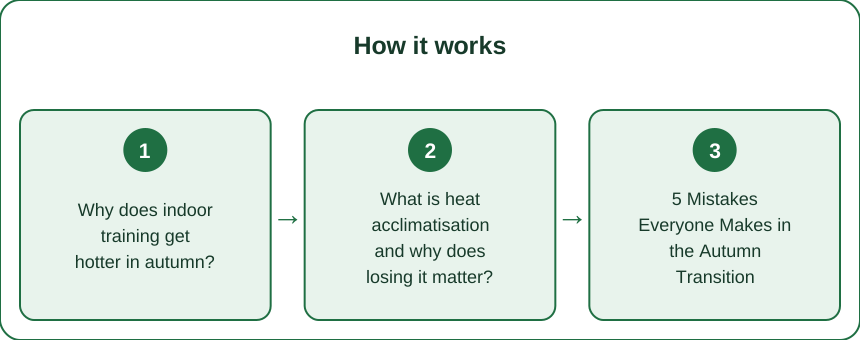
Why does indoor training get hotter in autumn?
Buildings turn the heating on based on outdoor temperature, not on what the people inside are doing.
Gym heating is often set for people standing still, which is a completely different requirement from people training.
Ventilation typically reduces in autumn as windows and doors close, so humidity builds inside far more than in summer.
Humidity is what actually limits cooling, because sweat only cools you when it evaporates - and it evaporates poorly into humid air.
A warm humid indoor gym can be harder to cool in than a warmer dry outdoor day, which is exactly the experience people report.
Studio classes are the worst case, since a room full of people generates substantial heat and moisture in a closed space.
What is heat acclimatisation and why does losing it matter?
Repeated exposure to heat produces measurable adaptations over a couple of weeks - you sweat earlier, more, and with a lower salt concentration, and plasma volume increases.
Those adaptations make summer training progressively more comfortable, which is why August feels easier than June.
They decay when the exposure stops, and meaningful decay begins within about a week to two weeks of cooler conditions.
Losing them changes the pattern rather than only the amount - sweating starts later and less efficiently, so heat builds before cooling begins.
Which is why a warm room in October feels harder than a hotter one did in August, at the same workload.
The adaptation rebuilds quickly if exposure resumes, which is why regular sauna or hot-room training keeps it through winter for those who want it.
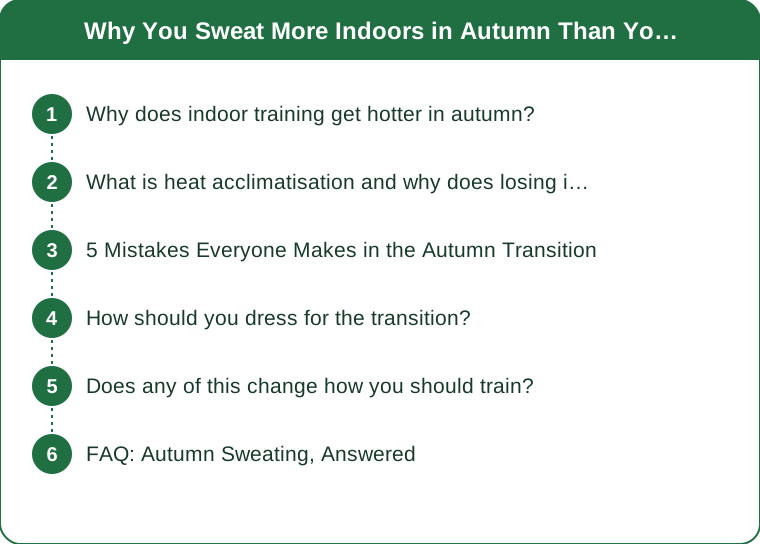
5 Mistakes Everyone Makes in the Autumn Transition
Keeping the outdoor layer on for the warm-up. The jacket that was right for the walk is wrong from the first set, and taking it off five minutes later than you should is enough to change the whole session.
Assuming hydration matters less because it is cold. Sweat losses in a heated indoor gym are often as high as in summer, and thirst is a weaker signal in cold weather.
Training in the same spot in the room. Air movement varies enormously within a gym, and moving away from a radiator or toward a fan is a free fix.
Wearing heavy cotton because it is autumn. Cotton holds sweat and stays cold, which is the worst combination for the walk home.
Judging fitness by how much you sweat. Sweat rate reflects acclimatisation, hydration, clothing, room conditions and genetics far more than fitness.
And going straight outside soaked. The cooling that felt good in the gym becomes a problem in cold air, and this is the actual mechanism behind feeling wrecked after autumn sessions.
How should you dress for the transition?
Layer for the walk, not for the workout, with an outer layer designed to come off immediately.
Wear synthetic or wool next to skin rather than cotton, so sweat moves away rather than sitting.
Bring a dry top for afterward, which is the single most effective change most people can make in autumn.
Underdress by one layer for outdoor sessions, since you will warm up within ten minutes and be over-layered for the remaining fifty.
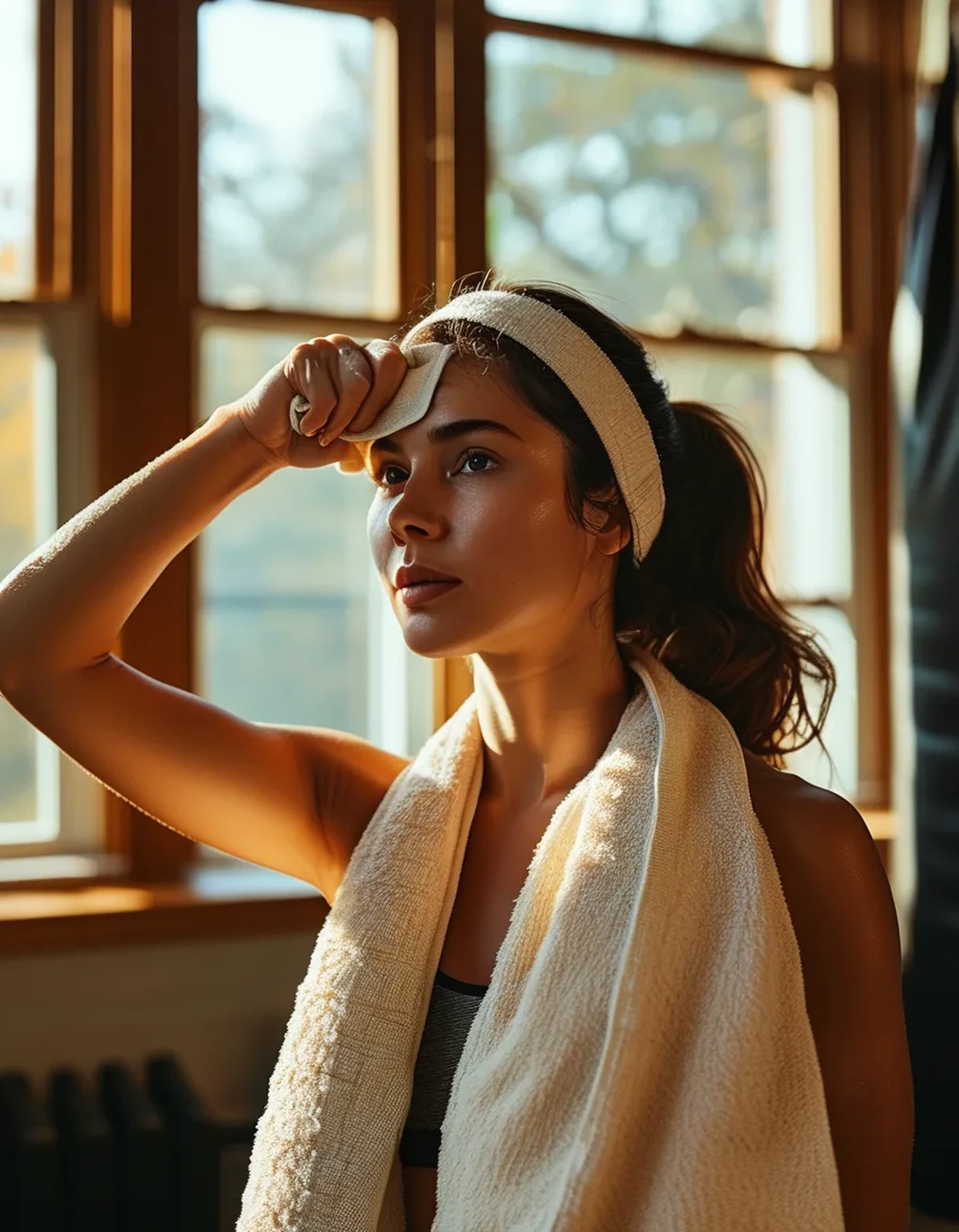
Keep a towel on you rather than at the bench, since sweat management matters more when the room is humid.
And change quickly after training rather than sitting in damp kit, which is where autumn chills genuinely come from.
Does any of this change how you should train?
Expect perceived effort to be slightly higher for the same work during the two or three weeks of transition.
Pace by effort rather than by numbers during that window, particularly for conditioning.
Hydrate deliberately, since thirst is a less reliable cue in cool weather and indoor sweat losses stay high.
Take an extra minute between hard sets in a hot room, since your cooling is less efficient than it was in August.
It settles within a few weeks as you adapt to the new indoor conditions.
And if you feel unusually unwell in heat - dizzy, nauseous, stopping sweating, confused - stop and cool down, since those are heat illness signs regardless of the season. This is general information, not medical advice.
FAQ: Autumn Sweating, Answered
Why am I sweating more in a cooler month?
Heated, less ventilated indoor spaces plus more clothing plus fading heat acclimatisation. The room is often warmer than summer air.
How fast do you lose heat acclimatisation?
Meaningful decay begins within roughly one to two weeks of reduced heat exposure, and it rebuilds quickly on re-exposure.
Does sweating a lot mean I am unfit?
No. Sweat rate reflects acclimatisation, clothing, room humidity, hydration and genetics far more than fitness.
Do I need to drink as much in autumn?
Often yes for indoor training, and thirst is a weaker cue in cool weather, so drink deliberately rather than by feel.
Why do I feel so cold after an autumn session?
Evaporating sweat plus cold air. Change into a dry top before you leave rather than after you get home.
When should I be concerned?
Dizziness, nausea, confusion, or stopping sweating while still hot are heat illness signs. Stop and cool down. This is general information, not medical advice.
TL;DR:
- Autumn gyms are often warmer and much less ventilated than summer air, and humidity is what limits your cooling.
- Heat acclimatisation built over summer decays within one to two weeks of cooler weather, changing when and how you sweat.
- Layer for the walk rather than the workout, and take the outer layer off before the warm-up, not after.
- Hydrate deliberately - indoor sweat losses stay high and thirst is a weaker cue in cool weather.
- A dry top for afterward is the single highest-value change for the autumn transition.
You lost an adaptation, not fitness, and it comes back. This is general information, not medical advice.
Keep Reading
This article is for general informational and styling purposes only. Fit, sizing, and product availability may vary.