The Temperature of Performance: Why Warm Muscles Simply Work Better
Quick Answer: Warm muscles perform better because heat changes three things: muscle fluid becomes less viscous so contractions flow faster, nerve conduction speeds up so coordination improves, and warm tissue tolerates lengthening so your range of motion expands. Roughly 5–8 minutes of rising general movement raises muscle temperature about two degrees — and those two degrees change nearly everything measurable.
The warm-up’s name is literal. It isn’t a metaphor for “getting ready.”
Muscle temperature rises about two degrees Celsius during a proper one, and those two degrees change contraction speed, stretch tolerance, coordination, and injury math. Here’s the physiology behind fitness’s most-skipped ritual, in plain heat.

Why Are Cold Muscles Slower?
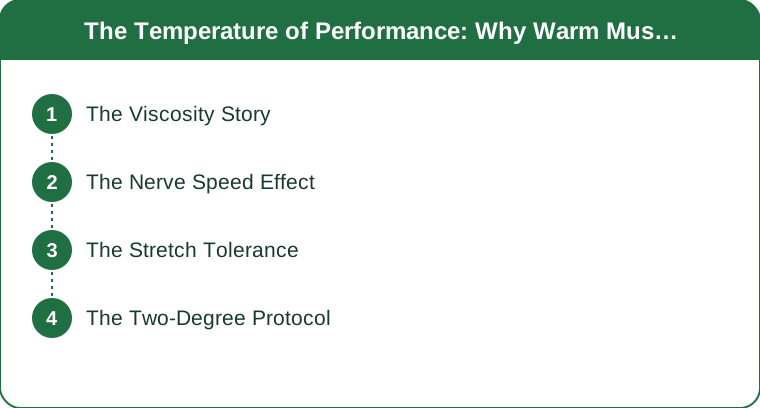
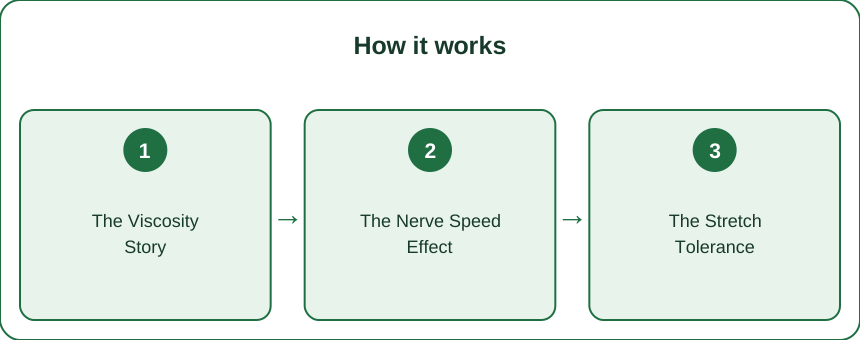
Cold muscle is literally thicker. Its internal fluid resists movement the way cold honey resists a spoon. This property — viscosity — falls as temperature rises.
Warming reduces that internal resistance, so contractions flow faster and movements cost less energy. The same effort produces more speed and more force.
There’s a slightly humbling corollary here: that first-set stiffness everyone blames on age is substantially just temperature. The 25-year-old who feels loose on set one has usually been walking around a warm gym, not winning a genetic lottery.
What Does Warmth Do to Your Nervous System?
Nerve conduction accelerates with warmth. Warm muscles receive their orders faster and coordinate between muscle groups more precisely. Reaction time and rate of force development both measurably improve.
This is why the first attempt at anything technical, done cold, feels clumsy. The clumsy-cold-first-rep phenomenon is electrical, not moral. You didn’t lose the skill overnight — the signals were just travelling slower.
It’s also why complex movements deserve more warm-up than simple ones. A cold set of machine curls costs you a little. A cold set of snatches costs you the technique.

Why Does Range of Motion Improve When You’re Warm?
Warm tissue tolerates lengthening. Measured range of motion expands with temperature — the same body, the same joint, more available range simply because it’s warmer.
Two practical consequences follow.
First, deep stretching belongs after warming, not before. Trying to gain range in cold tissue is fighting a property of the material. The timing rule everyone repeats now has its mechanism.
Second, cold-start maximal efforts write most of the strain stories. A muscle asked to lengthen rapidly under load — a sprint, a deep catch position, a sudden change of direction — is being asked to do the exact thing cold tissue is worst at. That’s the injury math.
Myth vs Fact
Myth: “Warming up is just a mental ritual.” Fact: The temperature change is measurable and so are its effects on contraction velocity, nerve conduction and tissue extensibility. The mental switch is a bonus, not the mechanism.
Myth: “Stretching is a warm-up.” Fact: Static stretching doesn’t raise muscle temperature meaningfully, and long holds before heavy or explosive work slightly reduce power output. Movement warms; stretching lengthens. Different jobs.
Myth: “Young or fit people don’t need one.” Fact: Viscosity and nerve conduction are physics, not fitness levels. Better-conditioned athletes typically warm up more thoroughly, not less.
Myth: “A longer warm-up is always better.” Fact: You want to be warm, not tired. Past roughly 10–15 minutes of general work you’re spending energy that belonged to the session.
How Do You Earn the Two Degrees?
5 to 8 minutes of rising general movement. That’s the whole protocol for the temperature part.
- Start easy — walking, easy cycling, easy rowing.
- Build gradually over the minutes rather than starting hard.
- The finish line is a light sweat. Genuinely warm means lightly sweating and mentally arrived. If you’re not slightly damp, you’re not there yet.
- Then get specific — dynamic mobility for the joints you’re using, and ramp-up sets for the movement you’re about to load.
- Add time in the cold. A 6°C garage gym in January costs you more minutes than a warm studio in July. So do early mornings, when everyone is stiffer.
The payoff schedule is simple: every quality the session cares about — power, range, coordination, comfort — improves on the warmth you deposited first.
FAQ
How long does a warm-up need to be?
Five to eight minutes of general movement to raise temperature, plus movement-specific preparation. Ten to fifteen minutes total for most training sessions, longer in cold conditions or early mornings.
Does a hot shower count as a warm-up?
Partly. Passive heating does raise tissue temperature and has a measurable effect, but it doesn’t deliver the nervous-system priming or the movement rehearsal that active warming does. It’s a supplement in cold conditions, not a replacement.
Should you stretch before or after exercise?
Dynamic movement before, static stretching after. Cold tissue resists lengthening, and long static holds before explosive or heavy work slightly reduce power. Stretch when you’re already warm and it works far better.
How quickly do you cool back down?
Faster than you’d like — muscle temperature starts dropping within a few minutes of stopping, and noticeably within about fifteen. That’s why long rest gaps, waiting for equipment, or a lengthy pause between warm-up and first working set undercuts the whole thing. Keep moving between sets on cold days.
TL;DR:
- A warm-up raises muscle temperature about two degrees, and that’s the whole mechanism.
- Warmer muscle is less viscous — contractions flow faster and cost less energy.
- Nerve conduction speeds up, so coordination and rate of force development improve.
- Warm tissue tolerates lengthening, which is why range of motion expands and cold maximal efforts strain.
- Protocol: 5–8 minutes of rising general movement until you’re lightly sweating, then specific prep.
- Dynamic movement before, static stretching after.
- Add minutes in cold conditions and early mornings; you cool back down within about fifteen minutes of stopping.
Keep Reading
This article is for general informational and styling purposes only. Fit, sizing, and product availability may vary.