Why Grip Fails Before Your Back Does on Heavy Pulls — The Science
Quick Answer: Grip fails first because it is an isometric contraction held continuously under high tension, while your back works concentrically with brief unloaded moments — and continuous isometric contraction restricts blood flow to the working muscle, which accelerates fatigue sharply. The forearm flexors are also small muscles with a high proportion of fast-fatiguing motor units for the load they are asked to hold. It is a physiological mismatch, not a strength deficiency.
Rep seven, your back feels like it has three more in it, and the bar is rolling out of your fingers. That happens to nearly everyone, and there is a specific reason.

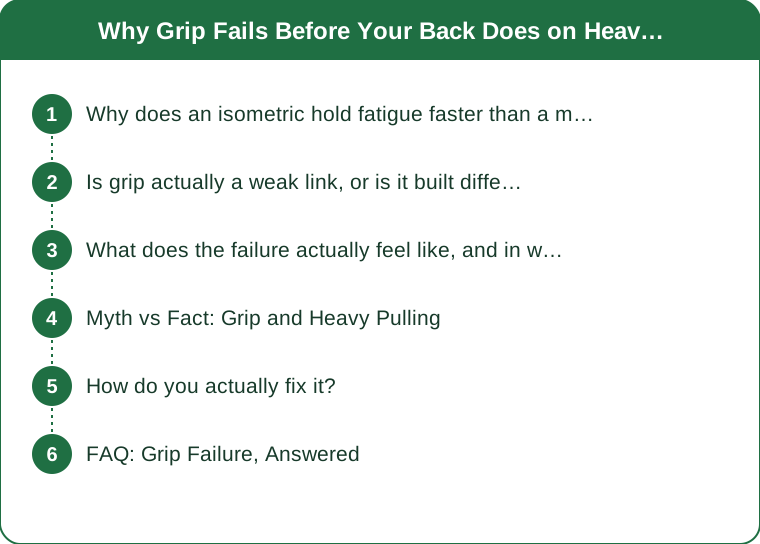
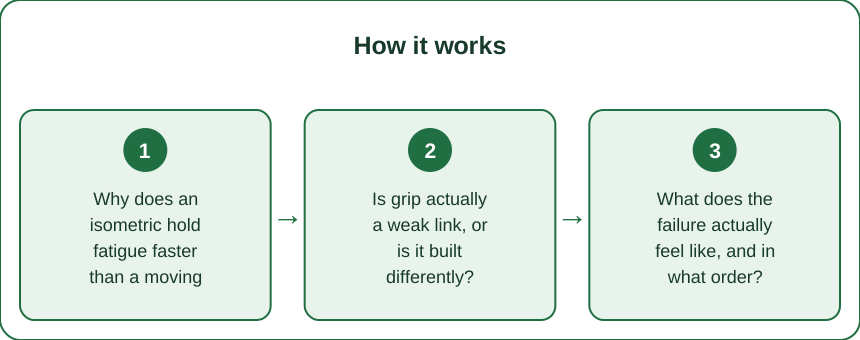
Why does an isometric hold fatigue faster than a moving contraction?
Because a sustained contraction squeezes shut the vessels supplying the muscle doing it.
When a muscle contracts, the pressure inside it rises, and above roughly 50 to 60% of maximal voluntary contraction, that pressure is enough to substantially occlude its own capillary blood flow. The muscle is holding hard enough to cut off its own supply line.
That has two consequences. Oxygen delivery drops, forcing a shift toward anaerobic metabolism. And metabolic byproducts cannot be cleared, so hydrogen ions and inorganic phosphate accumulate locally — and those directly interfere with the contractile machinery.
A dynamic contraction avoids most of this. Your back muscles alternate between high tension and lower tension through every rep, and each low-tension moment allows a pulse of blood flow. The pumping action of repeated contraction and relaxation actively perfuses the muscle, which is why moving work is sustainable far longer than holding.
Your grip gets none of that. From the moment the bar leaves the floor until you set it down, your finger flexors are at near-maximal isometric tension continuously. There is no relaxation phase anywhere in the set.
The maths is unforgiving. A muscle at high isometric tension with restricted flow reaches significant fatigue in tens of seconds. A set of five heavy deadlifts takes 20 to 30 seconds of continuous holding, plus the setup. Your grip is running a near-maximal isometric endurance test while your back runs five reps of strength work.
And it compounds across a session. Grip recovers more slowly than the large muscles it serves, so by your third or fourth heavy set, the grip is starting fatigued while the back is not.
Is grip actually a weak link, or is it built differently?
Both, in the sense that the mismatch is structural rather than a training failure.
The forearm flexors are small muscles moving long tendons. They generate force through a mechanically awkward arrangement — the muscles are in your forearm and the load is in your fingers, transmitted through tendons crossing two joints. Any loss of wrist position costs you force.
They also face a rotational problem no other muscle in the lift does. A heavy bar in an open grip does not just pull down, it rolls, and your fingers have to resist that rotation continuously. This is why a thicker bar destroys grip disproportionately — a fatter bar increases the moment arm the fingers must resist, which is the entire principle behind axle and fat-bar training.
Then there is the load ratio. Your posterior chain can move loads that are large multiples of what a pair of forearms was ever specialised to hold, particularly once you have been training for a year or two. Backs and hips respond to progressive overload quickly; grip responds more slowly because the tissue is smaller and the tendons adapt on a longer timeline.
Individual variation is large and mostly anatomical. Hand size, finger length, and tendon insertion points meaningfully change grip capacity, and none of them are trainable. Larger hands wrap further around a bar, which improves both friction and leverage. This is a real, permanent advantage and it is worth knowing it is not effort-related.
And sweat is a genuine variable, not an excuse. Friction between skin and steel is what actually holds the bar, and moisture reduces it substantially. Grip capacity on a humid day with damp hands is measurably lower than the same grip dry.
What does the failure actually feel like, and in what order?
There is a predictable sequence, and recognising where you are in it is useful.
Stage one: the bar starts to rotate. Your fingers are still closed and the bar is turning in them. This is the first mechanical sign and it is usually mistaken for a technique wobble.
Stage two: the fingers begin to open under load. You feel the bar sliding toward the ends of your fingers. You are now holding with the distal phalanges rather than the whole hand, which is a much weaker position, and the loss accelerates from here.
Stage three: the forearms burn and the hand feels uncoordinated. This is the metabolic accumulation — hydrogen ions interfering with contraction, plus reduced neural drive as the nervous system responds to the local environment.
Stage four: the bar leaves. Usually mid-rep, usually with the back and hips still capable.
The important observation is what happens to everything else during stages one to three. A failing grip degrades the whole lift before it drops the bar. Grip fatigue reduces the tension you can transmit up the arm, which subtly softens your lat engagement, which lets the bar drift forward. So a set that ends in a grip failure often had two or three reps of worse positioning before it — meaning grip was already costing you quality reps, not just the last one.
And a useful diagnostic: if your grip fails while your back genuinely still has reps, that is a limiter worth fixing. If they fail at roughly the same time, your grip is proportionate and nothing here needs solving.

Myth vs Fact: Grip and Heavy Pulling
Myth: Using straps means you are cheating and will never build grip. Fact: Straps let you load your back at a weight your grip cannot hold, which is the entire point. Grip is trained specifically and separately, and it responds well to that. The practical approach used by most strong lifters is to pull without straps until grip becomes the limiter, then strap up for the remaining volume and train grip directly.
Myth: A mixed grip solves the problem. Fact: It solves the rotation problem, which is a real and large part of it, and it introduces an asymmetry — one arm supinated, uneven loading across the shoulders and spine, and a genuine biceps tear risk on the supinated side under maximal load. It works. It is not free, and alternating which hand supinates matters.
Myth: Grip fails because your forearms are undertrained. Fact: Partly, and mostly it is the isometric-versus-dynamic mismatch described above. You could have proportionally strong forearms and still lose the bar because a continuous occluded contraction fatigues on a different timeline than intermittent work. Training helps; it does not remove the mismatch.
Myth: Chalk is a marginal gain. Fact: Chalk addresses friction, which is one of the two mechanisms actually holding the bar, and the difference on a sweaty day is not subtle. For many lifters it is worth more than any amount of forearm work, and it costs nothing.
Myth: Squeezing harder is the answer. Fact: Squeezing harder raises intramuscular pressure, which occludes flow further and fatigues you faster. The bar is held largely by hook position and friction, not by crush force. Setting the bar deep in the fingers at the joint crease, hanging rather than gripping, lasts longer than clenching.
How do you actually fix it?
Four levers, in descending order of return on effort.
1. Fix friction and position first, because it is free. Chalk. Then set the bar in the crease of your fingers rather than the palm — a bar sitting in the palm rolls the skin and forces the fingers to work at a longer, weaker length. Hook it deep, wrap the thumb over, and let the arm hang long rather than actively curling.
2. Use the grip variations deliberately. Hook grip — thumb under the fingers — is the strongest option and it is genuinely uncomfortable for the first weeks; it is what most competitive lifters use because it eliminates rotation without the asymmetry of a mixed grip. Mixed grip works, with the caveats above. Straps for volume work above the grip limit.
3. Train grip as its own quality, isometrically, since that is how it is used. Two or three short sessions a week is plenty:
- Heavy dead hangs or timed barbell holds at or above your working weight — 3 sets of 20 to 40 seconds, at the end of the session
- Farmer’s walks or heavy suitcase carries, which also load the trunk
- Plate pinches for the thumb, which is the most commonly neglected part
- A thicker bar or fat grips occasionally, to overload the rotation component
Progress by time under tension, not reps. Grip endurance improves quickly at first because much of the early gain is neural.
4. Order your session with grip fatigue in mind. Do heavy pulls before rows and carries, not after. A single set of heavy farmer’s walks before deadlifts will cost you your top set.
And expect the timeline. Grip strength improves noticeably in 4 to 8 weeks of direct work, and tendon adaptation takes longer — which is exactly why grip lags behind a back that gets stronger every month. If you get numbness, tingling, or wrist pain rather than fatigue burn, stop and get it looked at; that is a different problem. This is general information, not medical advice.
FAQ: Grip Failure, Answered
Should I stop using straps to force my grip to catch up?
No — that just reduces your back training. Pull your first working sets without straps so grip gets loaded heavy, then strap up to complete the volume your back needs, and add 5 to 10 minutes of dedicated isometric grip work at the end of the session. That trains both qualities properly instead of compromising each.
Why does my grip feel worse on some days at the same weight?
Hydration, hand moisture, humidity, how recently you trained pulling, and how much you have gripped earlier in the session all move it. Grip is also unusually sensitive to sleep and to cumulative fatigue, which is why it is often the first thing to feel off in a hard training week. Chalk and rest between sets recover more of it than most people expect.
Does grip strength matter outside the gym?
Quite a lot, as it happens. Grip strength is one of the more reliable general markers used in research on function and healthy ageing, largely because it reflects overall muscle mass and neural function rather than because the hands themselves are special. That makes carries and hangs worth doing for reasons beyond your deadlift.
TL;DR:
- Grip is a continuous isometric hold, which occludes its own blood flow above roughly 50 to 60% of max effort
- Your back gets a relaxation phase every rep and grip never does, so the two fatigue on completely different timelines
- A rolling bar makes it worse: thicker bars and open grips force the fingers to resist rotation as well as load
- Fix friction and hook position first, then hook or mixed grip, then straps for volume, then direct isometric grip work
- Train grip at the end of a session, expect 4 to 8 weeks for real change, and treat numbness as a different issue
The forearms are not letting you down. They are running a near-maximal endurance test with the tap turned off while your back does five reps of strength work, and the fix is to train the two as the separate qualities they are.
Keep Reading
This article is for general informational and styling purposes only. Fit, sizing, and product availability may vary.