The Science of DOMS: Why Day Two Hurts More Than the Day Right After
Quick Answer: DOMS soreness typically peaks 24-72 hours after exercise, not immediately, because the inflammatory and repair response to microscopic muscle fiber damage takes time to build — the delay is a biological process timeline, not a sign of a worse injury on day two.
Waking up more sore on day two than you were the day right after a hard workout feels backwards, but it’s actually the expected, well-documented pattern — here’s the physiology behind why.

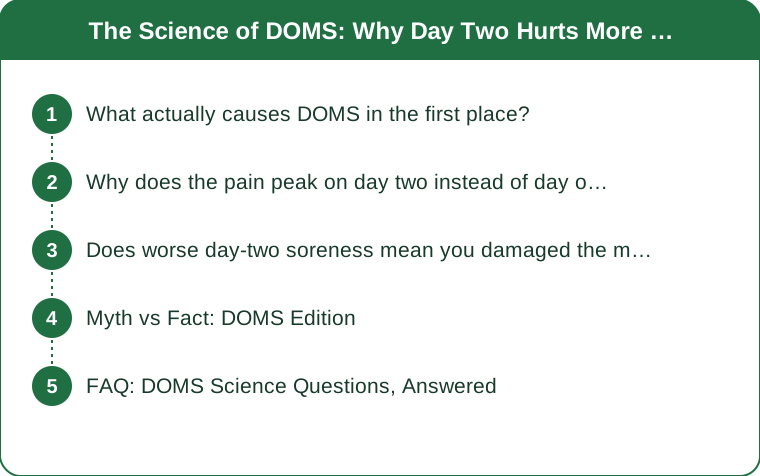
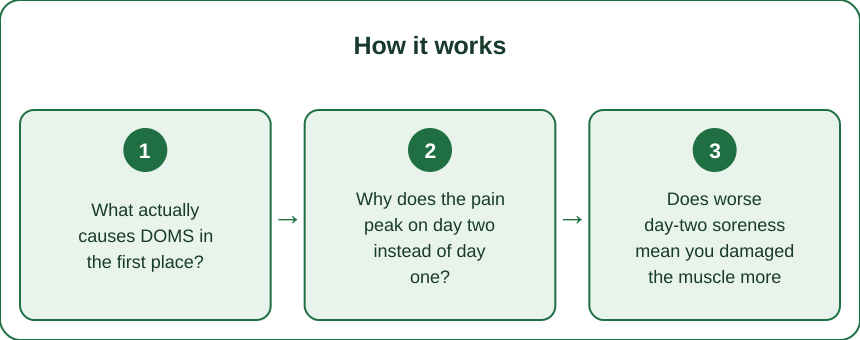
What actually causes DOMS in the first place?
Unfamiliar or intense exercise, especially movements with a heavy eccentric (lengthening) component like downhill running or the lowering phase of a squat, creates microscopic damage to muscle fibers. This isn’t the same as an injury — it’s a normal adaptive stress that ultimately leads to the muscle rebuilding slightly stronger, which is the basic mechanism behind progressive strength gains.
Why does the pain peak on day two instead of day one?
The initial microscopic muscle damage triggers an inflammatory response and fluid shift into the surrounding tissue, but this process builds over time rather than happening instantly — inflammatory markers and swelling generally continue increasing for 24-48 hours after the triggering exercise, which is why the sensory experience of soreness typically peaks a day or two later, not immediately.

Does worse day-two soreness mean you damaged the muscle more severely?
Not necessarily — soreness intensity correlates loosely, not precisely, with the amount of actual muscle damage, and factors like how unfamiliar the movement was to your body matter just as much as how hard you pushed. A first-time exercise often produces disproportionately severe DOMS compared to a familiar movement done at a similar intensity.
Myth vs Fact: DOMS Edition
Myth: DOMS means you had a great, effective workout. Fact: Soreness intensity isn’t a reliable measure of workout quality or muscle growth — a well-programmed, familiar workout can build strength effectively with minimal DOMS, especially as your body adapts to a movement over time.
Myth: You should always exercise through DOMS at full intensity. Fact: Light movement generally helps circulation and recovery, but training the same muscle group at full intensity while still significantly sore can compound damage rather than allowing proper repair.
Myth: Stretching before exercise prevents DOMS. Fact: Pre-exercise static stretching hasn’t shown a strong protective effect against DOMS in research — gradual load introduction and progressive training volume matter more.
FAQ: DOMS Science Questions, Answered
How long does DOMS typically last in total?
Most cases resolve within 3-5 days, with the peak commonly falling on day two, though severe cases from very unfamiliar or intense exercise can take up to a week.
Does DOMS mean muscle growth is happening?
Not directly — muscle growth results from the repair and adaptation process following training stress, but soreness itself isn’t a reliable indicator of how much of that adaptation actually occurred.
Is it safe to work out again while still sore from DOMS?
Light activity or training a different muscle group is generally fine; retraining the same very sore muscle group at full intensity is often better delayed a day or two to allow proper repair. This is general information, not medical advice.
TL;DR:
- DOMS comes from microscopic muscle fiber damage after unfamiliar or intense exercise
- The inflammatory response builds over time, which is why pain peaks around day two
- Worse soreness doesn’t necessarily mean more effective training or more damage
- Light movement helps recovery; full-intensity retraining of the same sore muscle is better delayed
The day-two peak is a well-documented physiology timeline, not a warning sign — understanding it removes a lot of unnecessary worry. This is general information, not medical advice.
Keep Reading
This article is for general informational and styling purposes only. Fit, sizing, and product availability may vary.