Overtraining or Just Normal Fatigue? The Science-Backed Way to Tell the Difference
Quick Answer: Normal training fatigue resolves within 24-72 hours of rest and doesn’t affect resting heart rate or mood significantly; overtraining involves fatigue that persists past a week despite rest, plus measurable markers like elevated resting heart rate, disrupted sleep, and mood changes — the distinction is duration and whether rest actually resolves it.
‘Am I overtraining or just tired’ is a common question with an actual measurable answer, not just a feeling-based guess — exercise science has clear markers that separate the two.

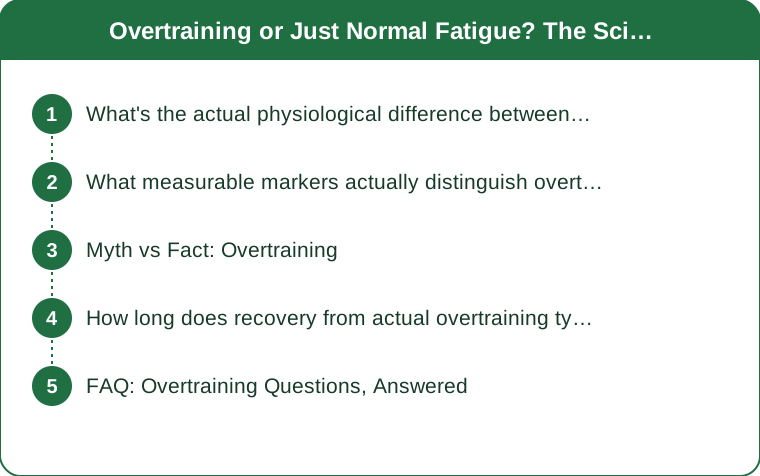
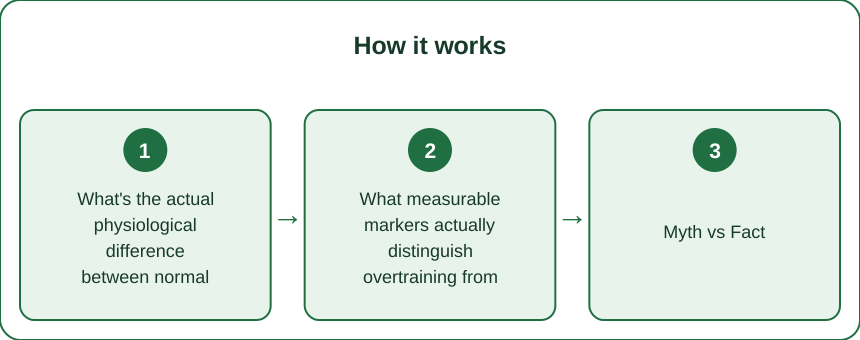
What’s the actual physiological difference between normal fatigue and overtraining?
Normal training fatigue is the expected result of exercise-induced muscle micro-damage and glycogen depletion, and it resolves through the body’s normal adaptation process within roughly 24-72 hours, leaving you stronger than before (that’s literally how training adaptation works).
Overtraining occurs when training stress consistently outpaces recovery capacity over weeks, leading to a state where the body can’t complete its normal adaptation process — performance doesn’t just feel harder, it measurably declines despite continued or increased effort.
What measurable markers actually distinguish overtraining from normal tiredness?
Resting heart rate elevated by more than 5-10 beats per minute from your normal baseline, measured first thing in the morning over several consecutive days, is one of the more reliable and easy-to-track markers. Heart rate variability (HRV) trending consistently downward over 1-2 weeks (trackable with many fitness wearables) is another research-supported signal.
Normal fatigue typically doesn’t move either marker meaningfully — a hard week followed by rest days shows a quick return to baseline, while overtraining shows a baseline that’s shifted and stays shifted.

Myth vs Fact: Overtraining
Myth: Overtraining just means being really sore. Fact: Soreness (DOMS) is a normal, separate response to novel or intense training and typically resolves in 2-4 days — overtraining is a distinct, longer-duration state involving hormonal and nervous system changes, not just muscle soreness.
Myth: You can push through overtraining with more discipline. Fact: Overtraining specifically involves the body’s inability to adapt to continued stress — more training in this state worsens the underlying problem rather than building fitness.
Myth: Only elite athletes actually overtrain. Fact: Recreational exercisers who rapidly increase volume or intensity, especially while under other life stressors (poor sleep, high work stress), can develop overtraining symptoms too — it’s not an elite-only phenomenon.
How long does recovery from actual overtraining typically take?
Meaningfully longer than normal fatigue — while normal fatigue resolves in days, documented overtraining syndrome can take several weeks to several months of significantly reduced training load to fully resolve, depending on severity and how early it’s caught. This is a major practical reason to catch it early through tracking rather than waiting for it to become severe and undeniable.
FAQ: Overtraining Questions, Answered
Does mood or motivation change count as a real overtraining marker?
Yes — persistent, unusual irritability, low motivation, or mood disturbance lasting more than a week, especially combined with physical markers, is a recognized part of the overtraining symptom picture, not just ‘being unmotivated.‘
Can sleep quality specifically signal overtraining before other symptoms show up?
Often yes — disrupted sleep (trouble falling asleep despite fatigue, frequent waking) is frequently one of the earlier signals, sometimes preceding the resting heart rate changes by a week or more.
What’s the first practical step if you suspect overtraining?
A planned reduction in training volume (not necessarily complete rest) for 1-2 weeks, combined with tracking resting heart rate and sleep, is the standard first response — persistent symptoms beyond that warrant a conversation with a doctor or sports medicine professional. This is general information, not medical advice.
TL;DR:
- Normal fatigue resolves in 24-72 hours; overtraining persists past a week despite rest
- Track resting heart rate and HRV — a sustained shift from baseline is a real marker, not just a feeling
- Soreness (DOMS) is separate from overtraining and resolves faster
- Recreational exercisers can overtrain too, especially with rapid volume increases plus life stress
This is general information, not medical advice — but the distinction is measurable, not just a guess about willpower.
Keep Reading
This article is for general informational and styling purposes only. Fit, sizing, and product availability may vary.