Muscle Memory Is Real: The Science of Never Truly Starting Over
Quick Answer: Muscle memory is real and it’s cellular. Training permanently adds myonuclei to your muscle fibers, and those nuclei survive months or years of detraining even after the muscle itself shrinks. That’s why a lapsed lifter regains a year of size and strength in roughly 6–12 weeks, while a true beginner needs 9–12 months to build it the first time.
You took six months off. Maybe a year. You walk back into the gym convinced you’ve torched everything you built, and the warm-up weight that used to be laughable now feels like a negotiation.
Here’s the part nobody tells you at the door: you didn’t lose the building. You lost the furniture.


What Is Muscle Memory, Scientifically?
Muscle memory isn’t a motivational metaphor. It’s two separate biological systems that both outlive your motivation.
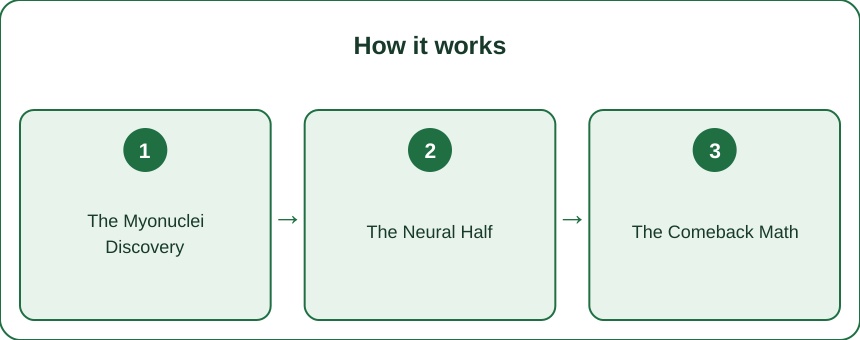
The first is structural. Muscle fibers are unusual cells — they hold many nuclei instead of one, and each nucleus governs a small territory of the fiber. Training recruits satellite cells that donate new nuclei to the fiber, expanding its capacity to build protein. The second is neural: the motor patterns that tell those fibers when and how hard to fire.
Detraining hits the two very differently. That gap is the whole story.
Why Do Myonuclei Matter So Much?
Because they’re the part that stays.
When you stop training, the muscle atrophies — fiber cross-section drops, and a noticeable amount of size can fade within 3–4 weeks of full inactivity. But the added nuclei largely persist. Not for days. For years, and in animal models possibly for the lifespan of the fiber.
So the comeback isn’t construction from bare ground. It’s re-staffing offices that are already built, wired, and waiting. The permits were pulled years ago.
That distinction has a practical consequence: you spend your comeback weeks on hypertrophy instead of on infrastructure.
What About the Neural Half?
Motor patterns decay far slower than fitness does.
Your squat groove, your swim stroke, the rhythm of a clean deadlift lockout — that coordination is archived, not deleted. Returning exercisers usually feel clumsy for two or three sessions, not two or three months. Week one feels foreign; by week three the pattern is back and the only thing missing is capacity.
This is why an ex-athlete looks technically sharp and physically deflated at the same time. The skill came back before the tissue did.
Myth vs Fact: The Comeback Edition
Myth: “Six months off means starting from zero.” Fact: Retraining studies consistently show previously trained people regain size and strength in a fraction of the original acquisition time — commonly a third or less. You’re resuming a save file, not booting a new game.
Myth: “The strength I lost first will come back last.” Fact: Strength typically returns ahead of size, because much of the early loss was neural drive, and neural drive rebuilds in weeks.
Myth: “Muscle turns to fat when you stop.” Fact: They’re different tissues and neither converts. Muscle shrinks; body fat rises if intake stays put while activity drops. Two changes, one mirror.
Myth: “I should jump straight back to my old working weights.” Fact: Your nuclei are ready. Your tendons are not. Connective tissue remodels on a slower clock — weeks behind muscle — which is exactly how enthusiastic comebacks turn into eight-week layoffs.

How Fast Will I Actually Regain?
The honest answer is a range, but it’s a generous one.
A reasonable comeback template: start at roughly 60% of your old working weights for the first week, add about 5% per session while the reps stay clean, and expect to be near your previous numbers somewhere between week 6 and week 12 for a lapse of six months to a year. Three full-body sessions a week beats five split sessions in this phase — frequency rebuilds patterns, volume rebuilds size, and your tendons get a vote in both.
Keep sets at 3 sets of 8–10 with two reps left in the tank for the first three weeks. It will feel too easy. That’s the correct feeling; the third week is where people who ignored this advice start reporting elbow pain.
The Psychology Rewrite
The finding’s real gift is narrative.
The all-is-lost despair that keeps lapsed exercisers lapsed is cellularly false. Every past training block you ever completed is banked infrastructure sitting there waiting for re-staffing. The season you lost to a new job, a new baby, a bad injury, or a long grey winter taxed the balance — it never closed the account.
You were never starting over. You were resuming.
Frequently Asked Questions
How long does muscle memory last?
Longer than most people assume. Myonuclei have been shown to persist for years after training stops, and in rodent studies they appear effectively permanent. Practical translation: a decade-old training history still counts in your favor, even if it doesn’t feel like it in week one.
Does muscle memory work for endurance too?
Partly. Aerobic fitness — VO2 max, mitochondrial density — declines faster and doesn’t have the same nuclear reservoir. But the movement economy and pacing sense return quickly, so returning runners usually rebuild in weeks rather than starting from a beginner’s baseline.
Do steroids or SARMs permanently bank muscle memory?
This is where the myonuclei research got misread in headlines. The data suggest enhanced training may leave a lasting nuclear advantage, which is one argument used in sport-doping bans. It’s also not a reason to touch anything: the health costs are real, and natural training already banks nuclei you keep.
A quick caveat: general fitness science isn’t personal medical advice. If your layoff came from an injury, surgery, illness, or a long period of medication use, get cleared by a physician or physical therapist before loading heavy again — comeback enthusiasm plus an unhealed structure is the single most common way this goes wrong.
TL;DR:
- Training permanently adds myonuclei to muscle fibers; detraining shrinks the muscle but largely spares the nuclei.
- Motor patterns are archived, not deleted — coordination returns in 2–3 sessions.
- Regaining runs far faster than gaining: expect near-baseline in roughly 6–12 weeks after a 6–12 month lapse.
- Start at ~60% of old weights, 3 full-body sessions a week, 3×8–10 with reps in reserve.
- Tendons remodel slower than muscle, so the limiting factor in a comeback is patience, not potential.
- You were never starting over. The account never closed.
Keep Reading
This article is for general informational and styling purposes only. Fit, sizing, and product availability may vary.