Why the Burning Feeling in a Hard Workout Isn't Actually Lactic Acid
Quick Answer: The burn in a hard set isn’t lactic acid. It’s hydrogen ions — a separate byproduct of rapid energy metabolism — dropping muscle pH and irritating nerve endings. Lactate itself is a fuel your body actively recycles for energy. That’s why “flushing out lactic acid” was never the right reason to cool down, even though easy movement is still useful.
Somewhere around rep nine, your quads start burning. And the explanation everyone reaches for — lactic acid pooling in the muscle — has been the standard answer for about a century.
It’s also wrong, and has been known to be wrong for roughly the last thirty years. The correction is more interesting than the myth.

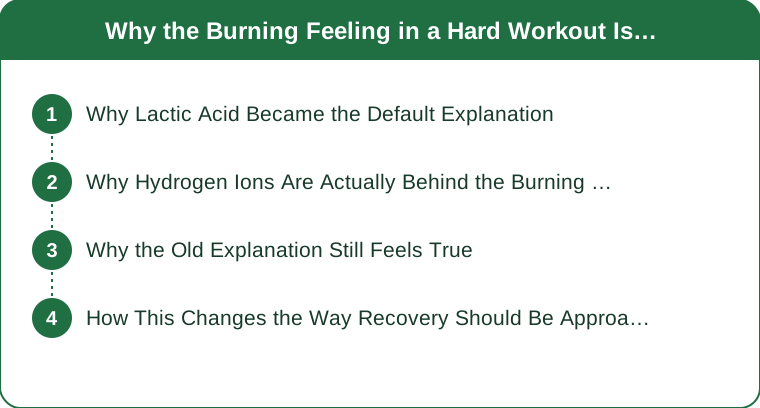
Why Did Everyone Blame Lactic Acid?
Because of a genuinely good experiment from 1907 that got over-interpreted for the next eighty years.
Researchers working with isolated frog muscle observed lactate accumulating alongside fatigue and concluded lactate caused it. Correlation, causation, and a very influential result — it went into the textbooks and stayed there.
The correction came from more precise biochemistry through the 1980s and 90s, particularly work showing that lactate is actively used as fuel rather than discarded as waste. But by then “lactic acid buildup” had escaped into gym vocabulary, personal trainer certifications, and popular fitness writing. Ideas that simple and that satisfying don’t leave easily.
There’s even a chemistry wrinkle: at physiological pH, what your muscles produce is lactate, not lactic acid. The acid form barely exists in your body. The phrase everyone uses is describing a compound that isn’t really there.

What Actually Causes the Burning Sensation?
Hydrogen ions, and the drop in muscle pH they cause.
During high-intensity effort, your muscles run glycolysis rapidly to produce ATP. That process releases hydrogen ions faster than the muscle can buffer or clear them. Accumulating H⁺ lowers intramuscular pH — from a resting value around 7.0 down toward 6.5 or lower during maximal effort.
That acidification does two things. It irritates specific nerve endings in the muscle, which your brain interprets as burning. And it interferes with the contractile machinery itself, which contributes to the force drop-off you feel as the set falls apart.
Lactate, meanwhile, is doing something entirely different: it’s being shuttled around and used as fuel. It moves out of working muscle into the bloodstream, gets taken up by the heart, the liver, other muscles, and the brain, and is either burned directly for energy or converted back to glucose. That transport system has a name — the lactate shuttle — and it’s a normal, continuous part of metabolism, not an emergency waste-disposal channel.
So the compound everyone blames is one of your better fuels.
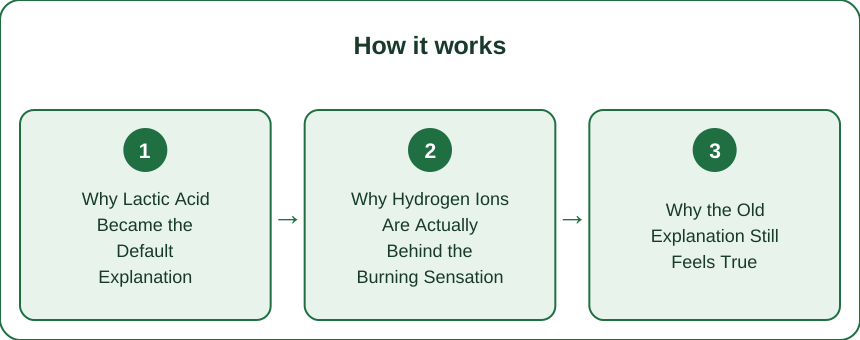
Why Does the Old Explanation Still Feel True?
Because lactate and hydrogen ions rise together, from the same metabolic pathway, at the same time.
If you measure blood lactate during a hard interval, it climbs — and the burn climbs with it. The correlation is real and tight. Lactate is simply the easier thing to measure, which is why lactate testing remains a genuinely useful tool for endurance athletes even though lactate isn’t causing the sensation.
It’s a marker, not a mechanism. Useful for what it indicates; misleading if you read it as the culprit.
Worth separating one more thing: none of this explains next-day soreness. DOMS peaks 24–48 hours after training and comes from muscle fiber microdamage and the inflammatory repair response, not from anything metabolic. Lactate clears from blood within about an hour of exercise ending. Whatever is making you sore on Thursday is not still sitting in your legs from Tuesday.
Myth vs. Fact
Myth: Lactic acid causes the burn. Fact: Hydrogen ions and the resulting pH drop cause it. Lactate rises alongside them and gets blamed for the company it keeps.
Myth: Lactic acid causes next-day soreness. Fact: DOMS is microdamage and inflammation, peaking at 24–48 hours. Blood lactate returns to baseline within roughly an hour.
Myth: You need to cool down to flush out lactic acid. Fact: Lactate clears on its own and is largely consumed as fuel. Active recovery does modestly speed lactate clearance and helps with circulation and the transition out of hard effort — good reasons, just not the one everyone gives.
Myth: Lactate is a waste product. Fact: It’s a usable energy substrate that the heart and brain in particular are happy to burn.
Does This Change How You Should Train?
Not dramatically, but a few things get clearer.
The burn is a signal, not damage. Metabolic burning is your body reporting a pH state. It doesn’t tell you a set was productive or that you injured something — sharp pain is a different sensation and deserves a different response.
Cool down, for the actual reasons. Easy movement after hard work supports circulation, helps clear metabolic byproducts generally, and eases the transition out of high sympathetic drive. Keep doing it; just don’t picture yourself flushing acid.
Lactate threshold training is still valid. Training near the intensity where blood lactate starts climbing steeply improves your ability to work at higher intensities. The training principle survives the mechanism correction entirely — you’re improving buffering capacity and clearance, not “reducing lactic acid.”
Buffering can be trained. Repeated high-intensity work improves your muscles’ capacity to handle hydrogen ion accumulation. That’s a large part of why the same interval that wrecked you in January is manageable in March.
FAQ
How long does it take for lactate to clear after exercise?
Blood lactate typically returns to near-baseline within 30–60 minutes of stopping, faster with light active recovery than with complete rest. This is one reason lactate can’t be responsible for soreness that peaks a day or two later.
If it’s not lactic acid, why do my muscles burn?
Hydrogen ion accumulation from rapid glycolysis lowers muscle pH, which irritates nerve endings and interferes with contraction. The sensation is a genuine physiological signal — it’s just reporting acidity, not a specific compound pooling in the tissue.
Should I still cool down after a hard workout?
Yes. Light activity for 5–10 minutes supports circulation, modestly speeds metabolic byproduct clearance, and helps your nervous system shift out of high-intensity mode. The benefits are real; only the lactic-acid explanation for them was wrong.
General exercise science information, not medical advice.
TL;DR:
- The burn comes from hydrogen ions dropping muscle pH, not from lactic acid
- Lactate is a fuel your heart, liver, brain, and other muscles actively use — not a waste product
- Lactate and H⁺ rise together from the same pathway, which is why the myth is so persistent
- Next-day soreness is microdamage and inflammation; blood lactate clears within about an hour
- Cool down anyway — circulation and recovery are real benefits, just not “flushing acid”
Keep Reading
This article is for general informational and styling purposes only. Fit, sizing, and product availability may vary.