Why You Sweat, Shake and Ache: Exercise Science Explained Like a Human
Every workout is a biology lecture your body delivers in sensations: the burn at rep twelve, the shake in a long plank, the mysterious two-days-later stair tragedy, the occasional wave of unreasonable happiness at minute thirty. Most of us just endure the sensations without ever getting the translation. Here it is — the science behind what you feel when you train, explained like a human, because workouts are more interesting when you know what the body is actually saying.

Sweat: Your Personal Cooling System
Sweat is not fat crying or toxins leaving — it is thermal engineering: working muscles generate heat, your brain’s thermostat responds by activating up to four million sweat glands, and the evaporation (not the dripping) carries heat away. Fitter people often sweat more and sooner — a trained cooling system starts early, like a good HVAC — so sweatiness is not a fitness report card in either direction. The practical footnotes: humidity blunts evaporation (why humid days feel brutal at the same temperature), and heavy sweating is the actual use-case for the electrolyte advice everyone else over-applies.
The Burn and the Shake: Live Commentary From Your Muscles
That building burn late in a set is largely acidity from fast energy production — your muscles burning fuel quicker than oxygen delivery can keep clean, a sensation (unfairly blamed on lactate for decades) that fades within minutes and signals you found the productive edge. The plank shake is different comedy: fatiguing muscle fibers dropping out mid-shift while your nervous system frantically rotates replacements — visible proof of recruitment at its limit. Both are effort signatures, not damage alarms. Sharp, sudden or joint-located pain is the different category that means stop; the burn and the wobble mean working.

DOMS: Why Stairs Betray You Two Days Later
Delayed-onset muscle soreness — peaking 24–72 hours post-workout — is microscopic muscle-fiber damage plus the repair inflammation that follows, triggered most by unaccustomed exercise and especially eccentric work (the lowering half of moves; hello, downhill hikes and slow squats). Rehabilitating its reputation: DOMS is not lactic acid (long since cleared) and not required for progress — soreness tracks novelty, not effectiveness, which is why week-three workouts build muscle while barely aching. What genuinely helps: light movement and blood flow, gentle stretching for comfort, sleep, protein — and time. What does not: punishing it with an identical brutal session while the repair crew is mid-shift.
The Runner’s High and the Mood Lift: Real Chemistry
The post-workout glow is pharmacology you manufactured: exercise releases endorphins (the famous ones) but the research spotlight has shifted to endocannabinoids — bliss molecules that cross into the brain readily and track that calm-euphoric after-feeling — plus dopamine, serotonin and, over weeks, BDNF: a growth factor that supports new brain connections and is a leading explanation for exercise’s stubbornly strong antidepressant showing in trials. The catch: the biggest mood chemistry rewards moderate, rhythmic, sustained movement — the brisk 30-minute effort — more reliably than all-out sprints. Your brain, it turns out, pays for consistency.
Adaptation: the Whole Point, in One Paragraph
Zoom out and every sensation serves one story: stress, recover, adapt. The workout itself makes you temporarily worse — depleted, damaged, tired; the adaptation happens after, during rest and sleep, when the body rebuilds slightly stronger, aerobically deeper, better fueled — which is why recovery is not the absence of training but its second half, why progressive overload (asking slightly more over time) is the only non-negotiable in every program, and why consistency embarrasses intensity over any timeline longer than a month. The sensations are the process talking. Now you speak the language.
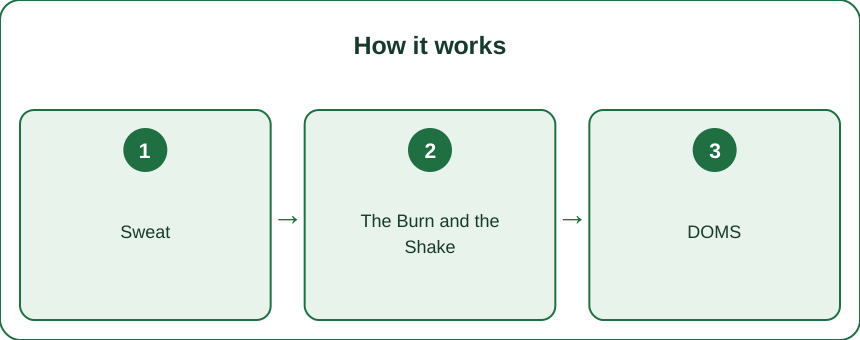
Your body’s workout vocabulary, translated: sweat is cooling, the burn is productive chemistry, the shake is full recruitment, DOMS is renovation noise, and the high is home-brewed pharmacology — all of it in service of adaptation, which happens while you rest. Next session, listen with the translation running. Exercise is the rare lecture where you are both the student and the subject — and now, finally, you have the notes.
Keep Reading
This article is for general informational and styling purposes only. Fit, sizing, and product availability may vary.