Does a Cold Shower After a Workout Actually Speed Up Recovery?
Quick Answer: Cold exposure after a workout can reduce perceived soreness and inflammation short-term, but research shows it may also blunt some of the muscle-building adaptations from strength training if used immediately and regularly — timing and training goals matter more than the trend suggests.
Cold showers and ice baths get treated as a universal recovery hack online, but the actual research is more nuanced, and the right answer depends heavily on whether your priority is muscle growth or feeling less sore.

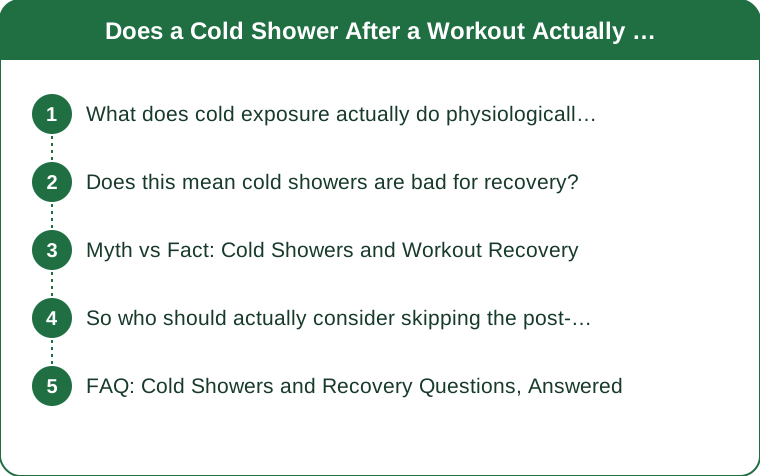
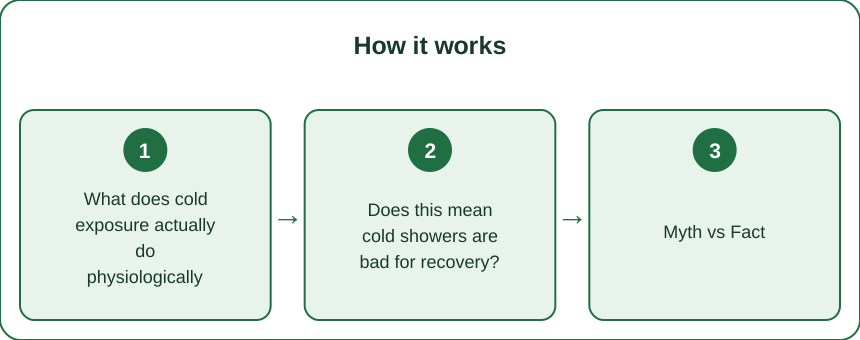
What does cold exposure actually do physiologically after exercise?
Cold temperatures cause blood vessels to constrict, which reduces blood flow, swelling, and the sensation of inflammation in worked muscles shortly after use. This is genuinely why perceived soreness often drops — but that same reduced blood flow also limits the delivery of nutrients involved in muscle repair and adaptation during the same window.
The effect that makes you feel better short-term is mechanistically linked to the effect that may blunt some long-term adaptation.
Does this mean cold showers are bad for recovery?
Not universally — the research specifically shows a potential downside for strength and hypertrophy goals when cold exposure happens immediately post-workout and regularly over time, based on several controlled studies. For general soreness relief, sport performance recovery (like between competition events), or simply feeling refreshed, the downside doesn’t clearly apply the same way.
The distinction that matters is your specific training goal, not whether cold exposure is ‘good’ or ‘bad’ in isolation.
Myth vs Fact: Cold Showers and Workout Recovery
Myth: Cold showers speed up muscle repair the same way rest and protein do. Fact: Cold exposure primarily reduces perceived soreness and inflammation — it doesn’t accelerate the underlying repair process the way sleep and nutrition do.
Myth: If cold exposure feels good, it’s automatically helping recovery. Fact: Feeling less sore and actually recovering faster are related but distinct — the numbing effect of cold can outpace the actual physiological benefit.
Myth: Any cold shower duration or temperature gives the same effect as research studies show. Fact: Most studies use specific, often colder and longer exposures (ice baths, 10-15 minutes) than a typical brief cold shower — real-world habits may not replicate study results exactly.
So who should actually consider skipping the post-workout cold shower?
If muscle growth or strength gains are your primary training goal, some research suggests waiting a few hours after training before cold exposure, or reserving it for lower-priority training days, may preserve more of the adaptation response. If your goal is general fitness, stress relief, soreness management, or you simply enjoy it, the tradeoff is far less significant and cold showers remain a reasonable habit.
This isn’t a case for avoiding cold exposure altogether — it’s a case for timing it around specific goals rather than defaulting to immediately after every session.
FAQ: Cold Showers and Recovery Questions, Answered
Is a cold shower as effective as an ice bath for these effects?
A cold shower produces a milder version of the same effect — ice baths used in most studies are typically colder and involve more total body surface immersion.
Does this research apply to cardio training the same way it does to strength training?
The hypertrophy-blunting concern is specific to strength and muscle-building adaptations — cardio recovery research doesn’t show the same clear tradeoff.
How long should I wait after strength training before cold exposure if I’m concerned about this?
Some research suggests a gap of several hours reduces the interference effect, though this is still an active area of study without one universally agreed number.
TL;DR:
- Cold exposure reduces perceived soreness and inflammation but may blunt some hypertrophy adaptations
- The tradeoff mainly matters for strength and muscle-building goals, not general recovery or stress relief
- Feeling less sore and actually recovering faster aren’t the same thing
- If muscle growth is the priority, delaying cold exposure by a few hours post-workout may help preserve adaptation
Cold showers aren’t a universal recovery hack or a mistake — they’re a tool whose right timing depends on what you’re actually training for.
Keep Reading
This article is for general informational and styling purposes only. Fit, sizing, and product availability may vary.